Currency in Portugal: EUR Send & Spend FX Guide
 Resources for Expats, Travelers and Entrepreneurs Navigating Life and Trade in Portugal with the euro.

What's in this Portugal currency guide?
What currency is used in Portugal?
The official currency of Portugal (country code: PT) is the euro, with symbol € and currency code EUR.
What is a good euro exchange rate?
The BestExchangeRates.com currency comparison table below helps you see the total cost of your currency transaction by showing the exchange rates offered by different providers. It also makes it easy to spot potential savings from market-leading FX services compared to bank rates.
To see a full list of rates, enter your transaction type, currencies and amount then click ‘GET RATES’:
Loading rates...
|
|
|
Good things to know about the euro
The euro (ISO: EUR) is involved in slightly more than 30% of all foreign exchange deals, and as such, is the world’s second most traded currency, behind the US dollar.
The euro is the currency of the eurozone (officially called the ‘euro area’), which consists of 19 of the 28 member states of the European Union, and is used by almost 350 million Europeans. It was introduced in January 1999.
Of all the thousands of exchange rates that exist in the world, the euro-to-US dollar exchange rate is the most actively traded, or most ‘liquid’.
Since its introduction, the euro’s lowest value against the dollar came in October 2000 when EUR/USD hit lows of 0.8231. The currency was strongest in July 2008, shortly before the worst stage of the 2007-2009 financial crisis, when EUR/USD reached 1.6038.
There are currently more than twenty nations and territories which peg their currencies to the euro, the largest of which is Denmark.
The euro banknotes and coins
The Euro is issued in banknotes of €5, €10, €20, €50, €100, €200, and €500, and in coins of 1 cent, 2 cents, 5 cents, 10 cents, 20 cents, 50 cents, €1, and €2.
The banknotes feature images of historical and cultural figures from across the European Union, while the coins depict each member country's unique design. The design of the Euro banknotes and coins is intended to be easily identifiable and difficult to counterfeit.
For more EUR information check out our selection of euro news and guides.
Frequently Asked Questions
What currency should I use in Portugal?
The domestic currency in Portugal is the euro.
What is the euro currency code and symbol?
The three letter currency code for the euro is EUR — symbol is €.
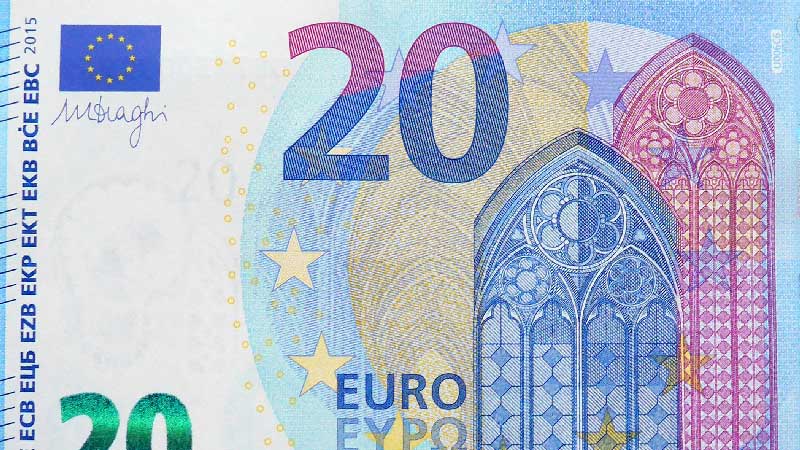
What does the euro look like?
Here is an example euro banknote:
Which countries use the euro?
It is the domestic currency in Eurozone, Aaland Islands, Andorra, Austria, Belgium, Bulgaria, Croatia, Cyprus, Estonia, Finland, France, French Guinea, French Southern Territories, Germany, Greece, Guadeloupe, Vatican City, Ireland, Italy, Latvia, Lithuania, Luxembourg, Malta, Martinique, Mayotte, Monaco, Montenegro, Netherlands, Portugal, Reunion, Saint Barthelemy, Saint Martin, Saint Pierre and Miquelon, San Marino, Slovakia, Slovenia and Spain.
Is the euro a closed currency?
No, the euro is freely available and convertible. See guide: What is a closed currency?
What are equivalent amounts of USD and EUR?
Here are some popular conversion amounts for USD to EUR (US dollar to euro)*.
*Converted at the current USDEUR interbank exchange rate. Calculate actual payout amounts for Send Money and Travel Money exchange rates.
Travel money for Portugal
Using Wise for euro travel money is a smart choice for savvy travelers. With its competitive exchange rates and low fees, Wise allows you to convert and manage multiple currencies effortlessly.
Be careful when using your own bank's Debit/Credit Card, as your bank may also charge an extra 3% as an “Overseas Transaction Charge” plus “Overseas ATM” fees for withdrawing cash on top of the standard Visa/Mastercard 2.5% from market mid-rate.
For card purchases, if you are offered a choice of currencies always select to Pay in euro otherwise you will typically get much worst dynamic currency conversion (DCC) exchange rates.
If you really want euro cash before departure, you can save money by ordering online. You generally get better rates and can pick up the EUR cash locally or even on travel day at the airport.
Portugal: Travel Guide
Traveling to Portugal requires careful financial planning to ensure a smooth and cost-effective experience. Here's a comprehensive guide to help you navigate currency considerations and manage your money effectively during your visit.
Portugal has been popular with European vacationers. Beaches and high mountains aside, the rest of Portugal is a diverse and verdant country of deep valleys and rolling hills dotted with stone-built villages. The country has with excellent sandy beaches and rugged coastline, as well as cosmopolitan and architecturally-stunning cities. Portugal is an affordable city, prices don't go to high and you can sleep comfortably and eat cheaply with ease.
A city metro ticket will generally start from 1.50 EUR. Inter-country trains and buses are inexpensive. Food, accommodation, wine is all very cheap, especially when compared to other EU countries. Taxis are a expensive way of getting around.
Everyday Costs in in Portugal
How much does it really cost to live, work, or travel in Portugal? Here's what to expect for daily expenses and expat living.
Currency Guide for Portugal (PT)
For travelers planning a mid-range stay in Portugal, budgeting around €1,200 for a week should cover a comfortable experience without breaking the bank. A typical daily breakdown of expenses can look like this: 🍽️ Meal at a local restaurant: €15-€25, ☕ Coffee: €1.50-€3, 🚍 Public transport fare: €1.50, 📱 Prepaid SIM card: €10-€15, 🏨 Budget hotel or Airbnb: €50-€100 per night. Overall, Portugal offers an average cost of living for visitors—it's more affordable compared to the United States, where similar expenses can tally up to 30-50% higher. When compared to the UK, travelers will find that Portugal tends to be less expensive, particularly in dining and accommodations.
For expats considering a move to Portugal, it’s vital to understand the typical monthly living costs. A single person can expect to spend around €800-€1,200 per month, depending on lifestyle choices. This includes housing, utilities, and general day-to-day expenses. When it comes to banking and card usage, you'll find that major credit and debit cards are widely accepted, but carrying some cash is advised for smaller establishments. For sending and receiving money, online transfer services like Wise or OFX often provide better exchange rates and lower fees than traditional banks, so you may find it more advantageous to use these services rather than exchanging money locally. Overall, embracing digital payment methods could lead to significant savings while living in Portugal.
USD/EUR Market Data
The below interactive chart displays the USD/EUR change and UP📈 DOWN📉 trends over the past 1 Year.
Recent euro Market News
EUR Market Outlook – March 2026
The euro remains range-bound in the current market environment, supported by a favorable Eurozone–US two-year rate differential. Despite geopolitical tensions and inflation concerns driven by rising oil prices, analysts expect EUR/USD to trade within a corridor of 1.1650 to 1.1850. Market sentiment continues to be influenced by prospects of Fed easing and the ECB's steady stance, with limited immediate change expected from policy shifts. The euro’s outlook is cautiously optimistic, maintaining resilience amid ongoing global uncertainties.
Key watchpoints
- Eurozone–US two-year rate differential supports EUR/USD in the 1.1650–1.1850 range.
- Market remains cautious amid geopolitical risks and inflation fears.
- The ECB’s steady policy stance contrasts with Fed’s easing expectations, impacting EUR strength.
For more EUR information read our News and guides to the euro.
Send Money to Portugal - Best Rates
To get a good (and fair) exchange rate when sending money to Portugal you need to find and compare exchange rates for International Money Transfers (IMTs).
The available FX rates for sending money abroad can be very different to the mid-market (wholesale) rate which you see reported online and in the News.
You should especially compare your own bank's exchange rates to those available from Money Transfer specialists to see how much you can save - we make that calculation easy in the below table.
Get a better deal for foreign transfers to Portugal
When sending money to Portugal it’s important to compare your bank’s rates & fees with those we have negotiated with our partner money transfer providers. To get a better deal you should follow these 4 simple steps :
- Open an account with a BER reviewed FX provider (id docs may be required)
- You specify the local or euro amount you want to transfer
- Make a local currency domestic transfer for the requested amount to the provider's bank account in your country
- Once your funds are received by the provider the converted EUR amount will be transfered to the recipient account you specify in Portugal.
Use the above calculator to compare the exchange rates of FX specialist providers rates versus your bank's standard rates you can hopefully save around 5% and maybe more - end result is more euro deposited into the recipient bank account and less margins and fees kept by the banks!