Weak South Korean Won Meets First Bank of Korea Rate Hike Since 2023
South Korea's first rate rise since 2023 changes the backdrop for the weak won, while market reforms aim to make KRW easier for overseas institutions to use.
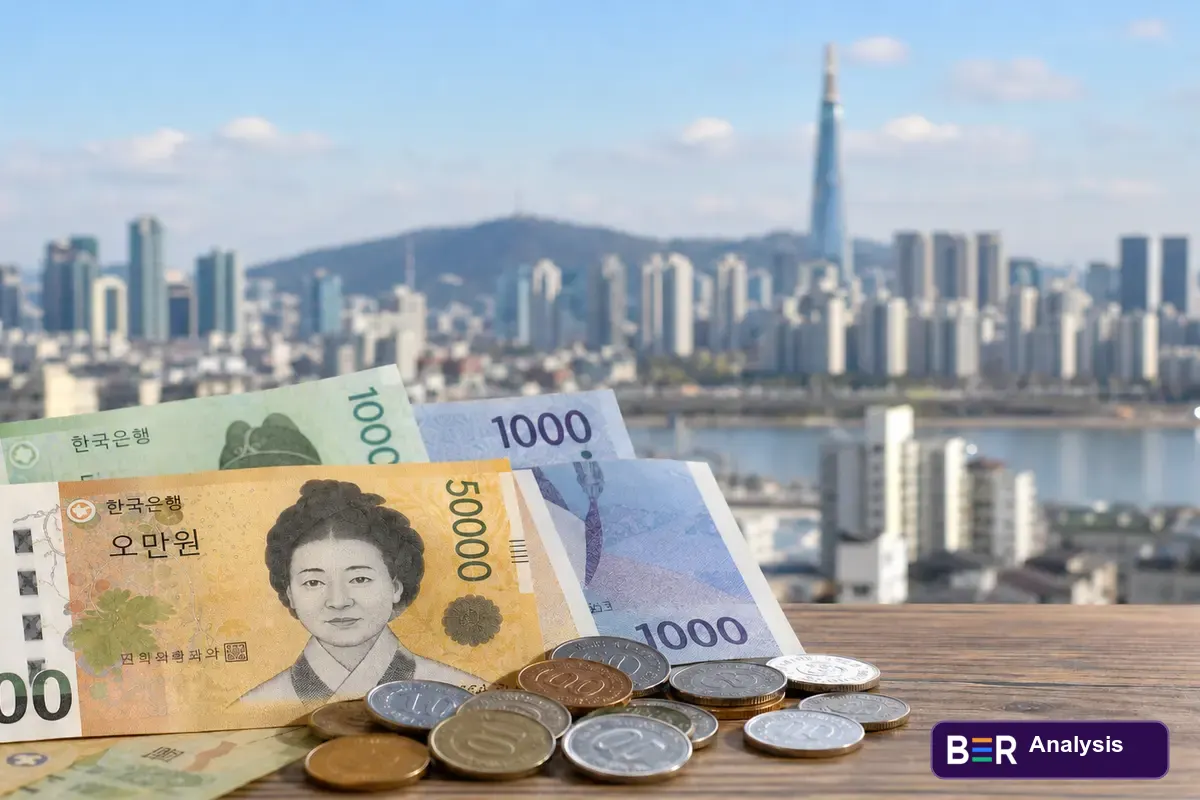
The South Korean won has been one of Asia's weaker currencies in 2026, improving the spending power of many visitors to South Korea while raising the cost of overseas travel and foreign-currency payments for Korean residents.
On 16 July, the Bank of Korea raised its Base Rate by 25 basis points to 2.75%, its first increase since January 2023. The decision changes the interest-rate backdrop for KRW, but the won's immediate response was muted and a higher policy rate does not guarantee that the currency will strengthen.
Seoul is pressing ahead with a major overhaul of the won market at the same time. The reforms are intended to make KRW easier for foreign institutions to trade, transfer and settle, potentially changing how international investors access the currency from 2027.
How the South Korean Won Has Performed in 2026
The won had lost 5.92% against the US dollar by 3 July compared with the end of 2025, according to Yonhap Infomax data reported by Yonhap News Agency.
The average exchange rate during the first half of the year was approximately 1,484.56 won per US dollar. That was the second-highest first-half average on record, behind only the same period in 1998 during the Asian financial crisis.
USD/KRW moved above 1,500 in March and was still above that level in early July. The move took the won to its weakest levels against the dollar since 2009 before it recovered some ground in July.
A rising USD/KRW rate means the dollar is strengthening against the won. A falling USD/KRW rate means the won is recovering.
The comparison is specific to the US dollar. KRW can perform differently against the Australian dollar, euro, pound or yen, so travellers should follow the pair that matches the currency they will exchange. BER readers can check live South Korean won rates and the latest USD to KRW rate.
Bank of Korea Raises Its Rate to 2.75%
The Bank of Korea's seven-member Monetary Policy Board unanimously increased the Base Rate from 2.50% to 2.75% on 16 July. Reuters described it as the first increase in three and a half years and reported that USD/KRW was little changed immediately after the widely expected decision.
The central bank said stronger exports and investment were supporting economic growth, while consumer price inflation had risen to 3.2% in June and core inflation remained at 2.5%. It also pointed to elevated exchange-rate volatility, rising household debt and faster housing-price growth around Seoul as financial-stability risks.
The Bank of Korea said its policy stance would remain consistent with the possibility of further rate rises. It did not commit to another increase, however: the timing and pace will depend on inflation, economic growth and financial-stability conditions.
Higher interest rates can sometimes support a currency by making its assets more attractive relative to markets with lower rates. That relationship is not automatic. The won is also responding to the US dollar, global risk sentiment, energy costs and foreign investment flows, which helps explain why the immediate market reaction was limited.
Why KRW Has Been Under Pressure
Several factors have contributed to the won's difficult year.
Foreign investors have sold Korean shares during periods of market stress and portfolio rebalancing. When investors convert the proceeds into dollars or another currency, they sell won, adding to downward pressure on KRW.
South Korea's reliance on imported energy has also mattered. Oil and gas are generally priced in US dollars, so higher energy costs can increase demand for dollars and make the country's import bill more expensive.
The won has also been affected by a strong US dollar, geopolitical uncertainty and demand from Korean investors buying overseas assets. These pressures have at times outweighed support from South Korea's semiconductor exports and current-account surplus.
The exchange rate does not reflect a single cause, however. Interest-rate expectations, global risk sentiment, energy prices, trade flows and foreign investment can pull KRW in different directions from one week to the next.
What a Weak Won Means for Travellers to South Korea
A weaker won can make South Korea better value for visitors whose home currency has strengthened against KRW. Their money may buy more won for accommodation, meals, shopping and local transport than it did when KRW was stronger.
For illustration, at a market rate of 1,500 won per US dollar, US$1,000 is equivalent to about 1.5 million won before fees and exchange-rate margins. A traveller will normally receive less because a bank, card issuer, ATM operator or cash-exchange service may add charges or use a customer rate below the market benchmark.
Visitors should compare the rate for their own currency rather than assuming every foreign currency has gained equally. Australian travellers, for example, can monitor the AUD to KRW exchange rate.
When a Korean card terminal or ATM offers a choice, paying in won generally leaves the currency conversion to the card network and issuer. Choosing a displayed amount in the traveller's home currency uses dynamic currency conversion, under which the merchant or ATM provider sets the conversion rate. Card foreign-transaction fees and ATM charges can still apply when paying in KRW.
The reverse applies to Korean residents travelling abroad. A weak won makes foreign hotels, tuition, imported products and overseas subscriptions more expensive in KRW terms.
South Korea Plans Easier Foreign Trading in Won
South Korea's government has now detailed its next steps towards a more internationally usable won.
From January 2027, foreign investors using approved overseas financial institutions are expected to be able to conduct won transactions without opening their own KRW account in South Korea. Most won transfers between foreign participants using the new channel will be exempt from advance reporting, although domestic real-estate transactions will remain subject to controls.
A new 24-hour settlement network operated by the Bank of Korea is due to begin pilot operations in September 2026 ahead of the planned 2027 launch. This builds on the July introduction of round-the-clock trading in South Korea's domestic foreign-exchange market.
The government also wants to encourage more deliverable won trading, expand foreign access to Korean bond and repurchase markets, and allow non-residents to put idle KRW balances into short-term investments.
These measures matter mainly to banks and institutional investors rather than holidaymakers exchanging cash. Over time, however, a deeper and more accessible KRW market could improve liquidity and price discovery across the currency.
Could the Reforms Strengthen the Won?
The reforms may support demand for KRW if easier settlement attracts more international investment into Korean shares and government bonds. They also address some of the market-access concerns that have prevented South Korea from being classified as a developed market by MSCI.
MSCI said in its June 2026 review that the won was not yet deliverable offshore and that liquidity during extended trading hours remained insufficient. The index provider is likely to judge the reforms by their practical adoption, trading depth and reliability after implementation.
More open markets do not guarantee a stronger currency. Easier access can facilitate both inflows and outflows, while near-term KRW performance will continue to respond to the US dollar, energy prices, interest-rate expectations and investor sentiment.
For travellers and people making international transfers, the immediate issue is therefore the exchange rate available today rather than the direction KRW might take after the 2027 rollout.
Practical KRW Takeaway
People planning a South Korea trip or a large KRW payment can reduce conversion risk by checking the live rate and comparing the final amount received after all margins and fees.
Exchanging in stages may suit travellers who do not want their entire budget tied to one day's rate. A rate alert can also help users follow a preferred KRW pair without trying to predict the market.
The live comparison below uses current rates and will differ from the historical levels discussed in this story.
Methodology and Sources
This story was researched on 20 July 2026. Market performance was observed through 3 July for the year-to-date comparison, with developments through 19 July used for the policy and market-reform updates. Rates, regulations and rollout schedules can change after publication.
- Bank of Korea: Monetary Policy Decision and press conference, 16 July 2026
- Reuters: Bank of Korea raises rates for the first time in three and a half years
- South Korean Ministry of Finance and Economy: FX market reforms
- Yonhap News Agency: won performance during 2026
- MSCI 2026 market classification review
- Bloomberg: detailed plan for foreign won trading
This article is general information, not personal financial advice.
Disclaimer: Please note any provider recommendations, currency forecasts or any opinions of our authors should not be taken as a reference to buy or sell any financial product.